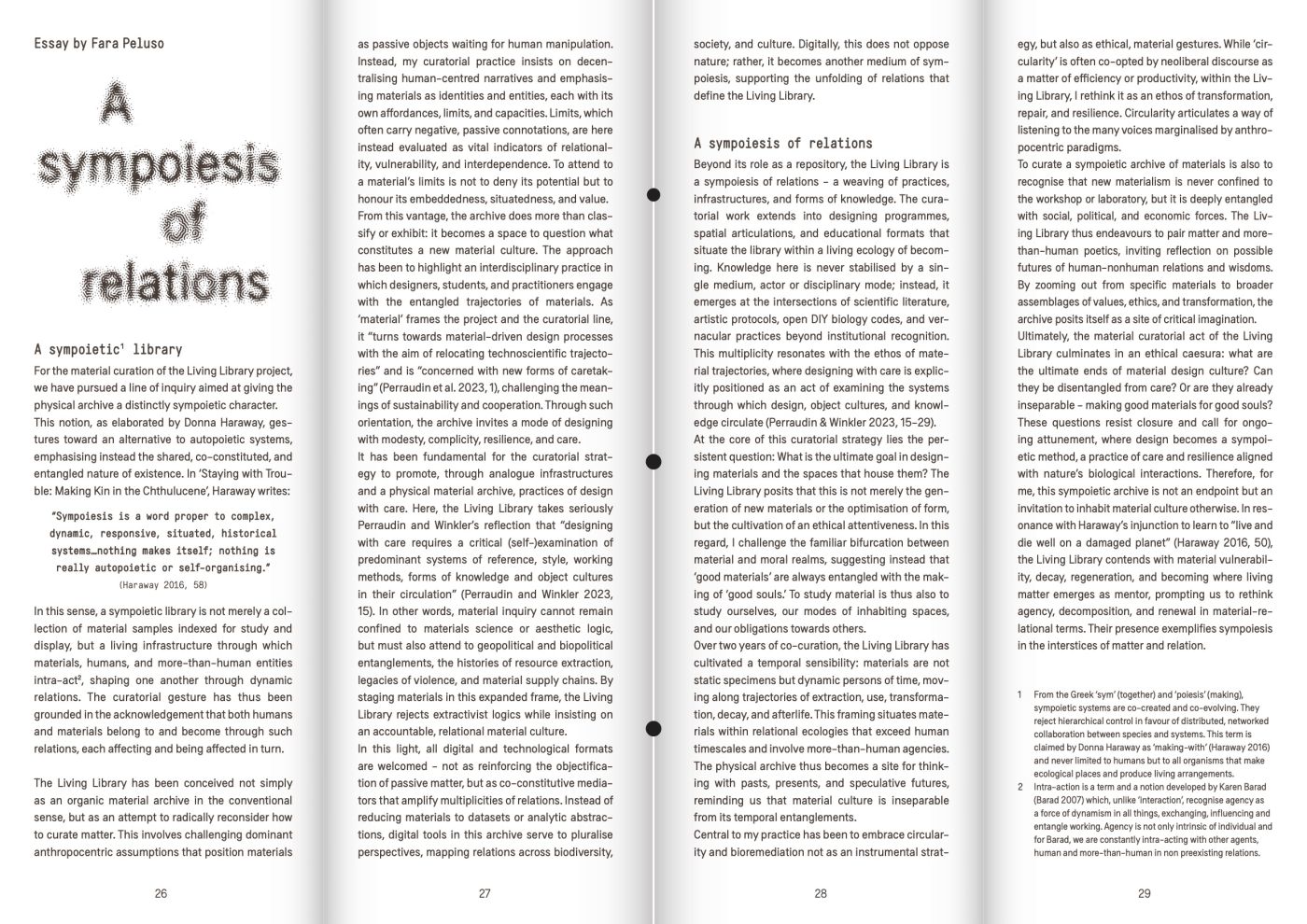
Pages from the Open Access Publication.
© Living Library / Bio Design Lab
The open access publication is the final ‘output’ of the project. It is available in two editions: a printed and a digital version. Both were created with sustainability and circularity in mind and gather two years of experiments, workshops, and discoveries, passing them into the hands of future readers and practitioners.
The print edition reflects a commitment to minimising waste and to following the manifesto, while acknowledging that the publication is situated within an industrial material cycle rather than a raw-material cycle. This commitment is reflected both visually and conceptually. Instead of replicating the rich colour palette used for the digital maps, the print version uses only a single brown plant-oil-based ink to lower environmental impact. Furthermore, the printed version uses 100% recycled paper without added bleaching and is bound with compostable yarn made from European hemp fibres spun in France.
The digital edition, though intangible, also carries an afterlife of its own. As long as the website remains online, the original PDF file will be available. Copies may also circulate via other websites, personal hard drives, institutional archives, or independent platforms until, one day, they are no longer relevant or lose their value. In this way, the digital form mirrors a resistance to permanent presence, while enabling continuation of the project’s ideas in a decomposed and regenerated form.
Despite these careful decisions, the act of publishing (whether on paper or online) inevitably leaves traces. Paper, pigment, energy, and even digital storage all carry environmental costs. Industrial cycles are also incredibly complex. Materials such as compostable paper made from hemp or grass may appear to be the more sustainable option. However, in contexts where organic waste management is limited and paper recycling infrastructures are well established, recyclability can outweigh the potential benefits of composting.
Rather than offering a perfect solution, the publication embodies an ethic of awareness: each decision on format, pigment, or binding was weighed against alternatives to align as closely as possible with the project’s values. This reflects a broader understanding of sustainability as a dynamic concept. Its meaning shifts with context, technology, science, and cultural perspective.
Sustainability is a collective process: knowledge, like fertile soil, grows stronger when it circulates freely. Because the project was made possible through public funding, all documentation is published under a Creative Commons CC BY-NC 4.0 licence. Knowledge is material to be broken down, redistributed and reactivated rather than locked away. Five hundred printed copies were distributed free of charge, and the digital version was made available for download.
Despite being the conclusion of the project, the publication is not intended as an endpoint but as part of a cycle. Everything may be reused without permission, adapted into new contexts with appropriate attribution, or developed into something completely different.
Credits
The Living Library
ISBN 978-3-930194-30-8
First edition, March 2026
Funded by the Foundation for Innovation in Higher Education Teaching
(CC BY-NC 4.0) Karlsruhe University of Arts and Design
and the authors
Publisher
Karlsruhe University of Arts and Design
Editorial lead
Pleun van Dijk
Writers
Julia Ihls, Pleun van Dijk, Jaap Knevel, Fara Peluso
Essayists
Franziska Müller-Reissmann, Katharina Mischer and Thomas Traxler, Severin Geißler, Yasmine Ostendorf-Rodríguez
Graphic designer
Severin Geißler
Proofreader
Eliza Collin
Typeface
G2 Erika, designed by Moritz Appich
Printer
Stober Medien