Situated along the public walkway between the Center for Art and Media (ZKM) and the State Art Gallery Karlsruhe - two of the three museums with which the HfG Karlsruhe shares the building - the physical Living Library functions as both a biomaterial archive and a workspace accessible to students and museum visitors. Conceived as a living, evolving ecosystem rather than a static collection, it explores what it means to design for sustainability and transformation through materials that grow, change, and decay over time. This hybrid setting, where materials, students, and visitors meet, emerged naturally from the building’s role as a public space.
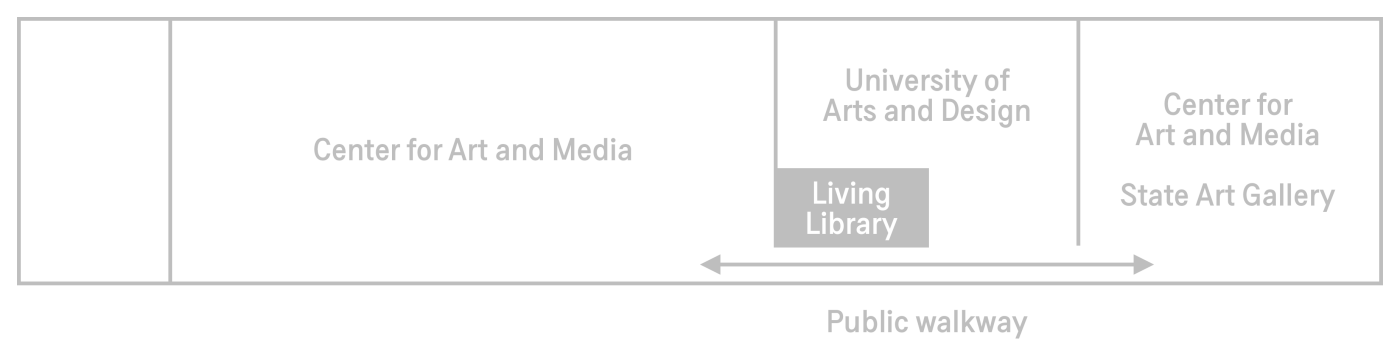
The physical Living Library collects and shares biomaterials and bioregional knowledge located around the university. It begins with the materials: samples that allow students to study physical and sensory qualities, tools and recipes stored in dedicated workshop boxes for immediate experimentation, and processed materials created during workshops held as part of the educational programme. The second layer focuses on material knowledge: including large maps that trace the locations of local material resources, books and guides from other researchers and makers, and video documentation from field trips to regional artisans and small-scale manufacturers. The third layer addresses the conceptual questions that underlie the project: What happens to materials after use, how do they decay, and how might they be remade or returned to ecological cycles? Together, these three layers (material samples, material knowledge, and material concepts) provide students with a comprehensive understanding of biomaterials in the region.
A workspace as a living system
The physical Living Library began as an almost empty archive, displaying only a few materials from the Bio Design Lab in a shelving system, which had previously occupied the space before relocating. The Bio Design Lab also left behind four large tables that later formed the basis of the workspace. Over the course of the two-year project, the archive and workspace slowly expanded with new materials and tools. The space itself evolved too: two large walls were added for bioregional maps, television screens were installed to show the website and field trip documentation.
Like the materials it holds, the physical Living Library functions as a living system that needs ongoing care. Unlike materials such as plastic, which may take hundreds of years to decay, biomaterials sometimes break down within weeks. The continuous addition of new material knowledge and concepts also required a flexible structure that could be adapted easily, reflecting an ongoing process of design research that investigates how materiality, transformation, and end-of-life are understood. Books were added regularly and regional maps were reprinted to include new findings.
Drawing on the DIY materials movement, the physical Living Library supports local communities by bringing their practices into visibility and enabling local knowledge transfer. These perspectives helped to shape the participatory aspects of the Living Library’s space, where visitors, students and scholars are not only spectators but also potential contributors.
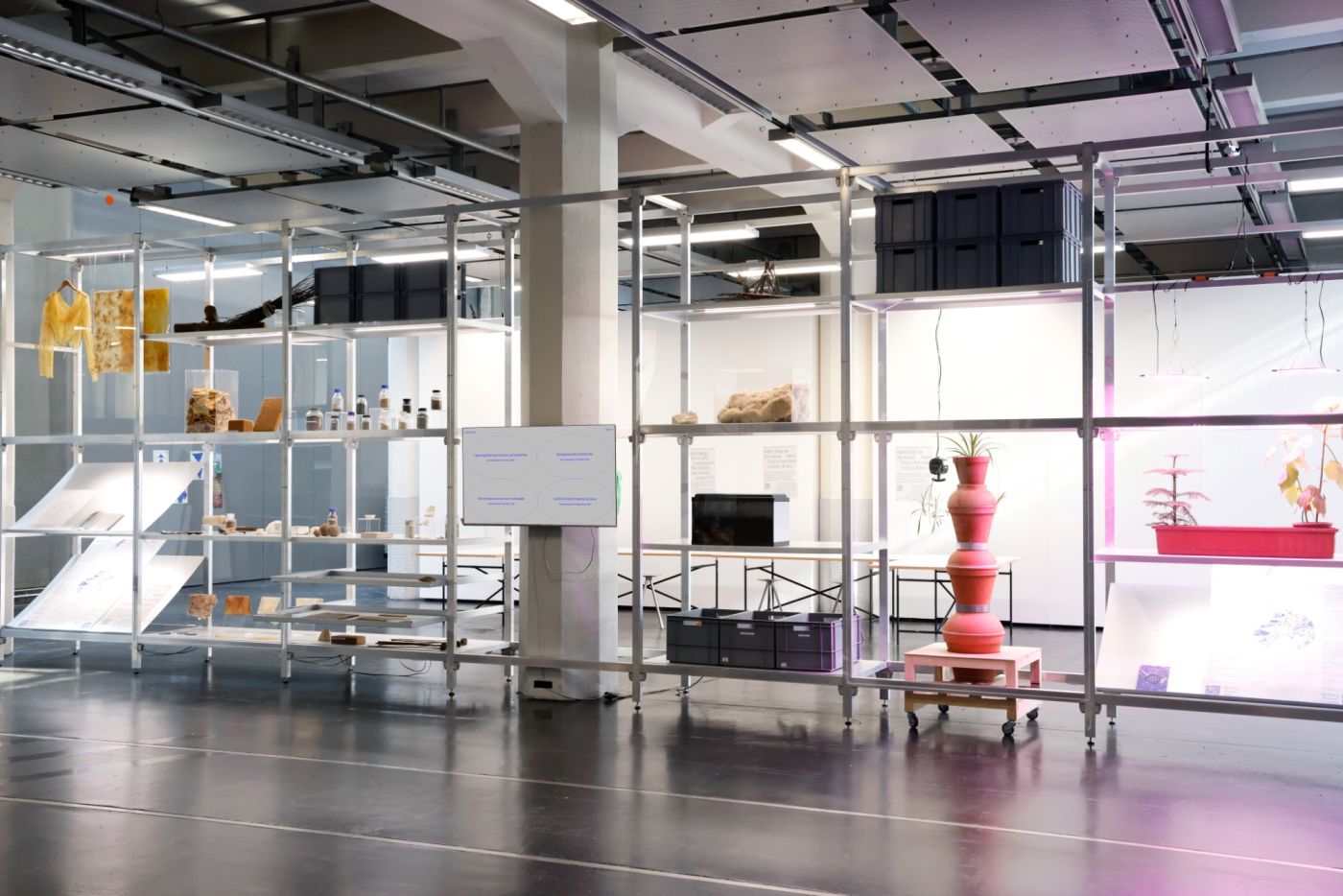
Material archive and compost area of the physical Living Library.
© Bio Design Lab / Felix Harr
Inspired by Franziska Müller-Reissmann, the first guest invited to participate in the Living Library and a contributor to this publication, the archive features a living and participatory element: a worm composter that transforms waste into soil. It embodies materials as living agents within a cyclical system. This aquarium composter (the first experiment was shaped like a tower built using terracotta flower pots) is home to hundreds of worms that decompose organic matter and turn it into nutrient-rich soil, making visible the otherwise hidden processes of decay and renewal.
Although the worms occupy only a small part of the space, their impact on the physical Living Library was profound. They transformed the archive from a collection of static samples into a circular ecosystem. They redefined the curatorial approach, presenting materials across their life cycles, from harvest to decay. Every material in the archive will ultimately become food for the worms. Sustainability in the physical library is framed as an act of care for materials, from their origin to their end-of-life, transforming waste into a resource and fostering resilient systems capable of adapting and enduring.
The archive and workspace
The physical Living Library took the form of an open shelving system and adjoining workspace that together acted as both archive and laboratory. Organised into clear, accessible sections, the shelves invited direct exploration: materials that could be handled were placed within reach, while more fragile or archival items were stored above. Thus, the physical library becomes a living ecosystem to be explored through the senses. Students and visitors could observe, touch, and compare samples, follow their stories through maps, books, and documentation, and connect practical knowledge to the wider bioregional context.
The space was designed to remain in motion. Materials were moved, replaced, and reinterpreted as new findings emerged, and the flexible structure allowed it to evolve continuously throughout the project. The same environment hosted field-trip reflections, workshops, and public colloquia, turning the archive into an active site of learning where theory, research, and making converged.
Even outside the university’s schedule, the steady flow of museum visitors kept the space alive. Many paused to study the large bioregional maps, browse the collection, or engage with students at work, transforming the Living Library into a shared zone of encounter between academic and public life.
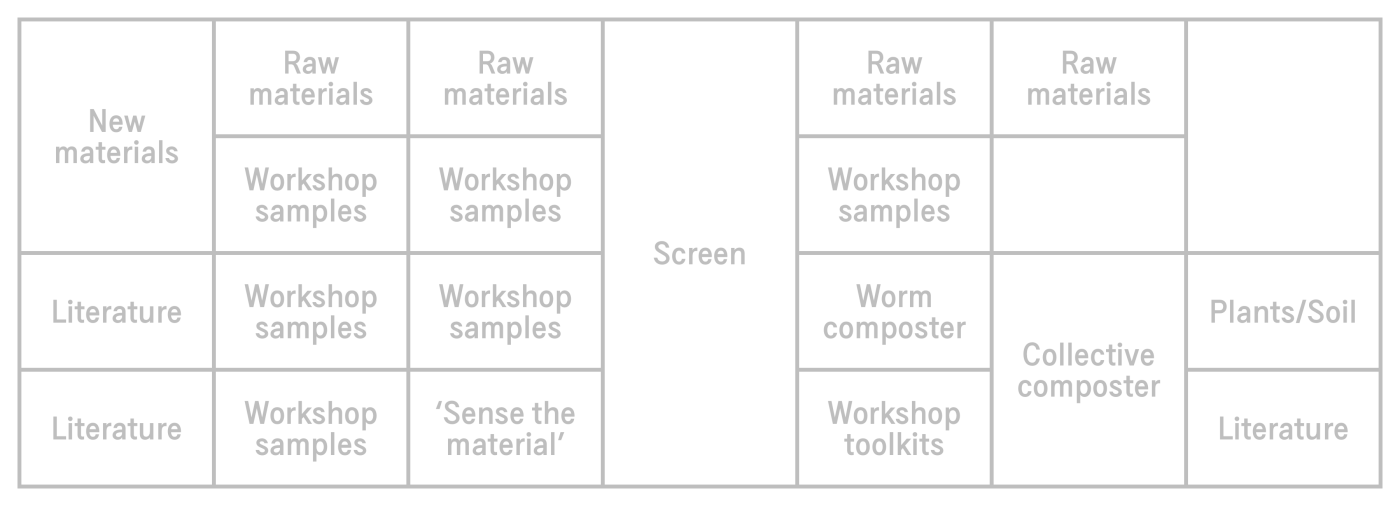
Material journey – Front view of the material archive and compost area.
Cross contamination
The physical Living Library fostered what might be called cross-contamination: an open exchange between materials, people, and ideas. Here, materials were understood not as passive matter, but as active participants carrying ecological and cultural meaning. It prompted reflections on daily habits, use, disposal, and the broader material flows.
Within this framework, the physical Living Library operated as a form of design research that questioned how materiality, design, manufacturing, and end-of-life solutions are explored in an academic and public setting. Both the archive and the workspace were constant works in progress, which, like the materials, shifted through environmental changes and human interaction.